
Two claims circulate about gonadorelin, and neither survives contact with a calculator. One says it’s just the body’s own hormone, so what’s there to worry about. The other is undocumented alarm from forum threads with no citation attached. Both skip the step that actually matters: reading the trials and counting what happened to the people in them.
So that’s what follows. Not a vibe, not a reassurance, a tally. The organizing question here isn’t “is gonadorelin safe” (that phrasing invites a yes/no that the data doesn’t support). It’s closer to: which claims about gonadorelin’s safety are backed by a single small cohort, which are backed by pooled data across studies, and which are just regulatory fact dressed up as a safety claim? Sorting the evidence that way, by tier rather than by how confident the sentence sounds, turns out to be more useful than the usual list of side effects.
Gonadorelin use in men is off-label and available only by prescription. Whatever your personal risk profile is, that’s a conversation for you and a licensed clinician, not a paragraph on the internet.
The scorecard, before anyone’s opinion of it
Here’s what the published data actually shows, expressed as counts against the group studied rather than as an adjective.
| Safety signal | What the data shows | Source |
|---|---|---|
| Overall tolerability (supervised, pulsatile) | Investigators called it effective and safe in CHH cohorts | [6] |
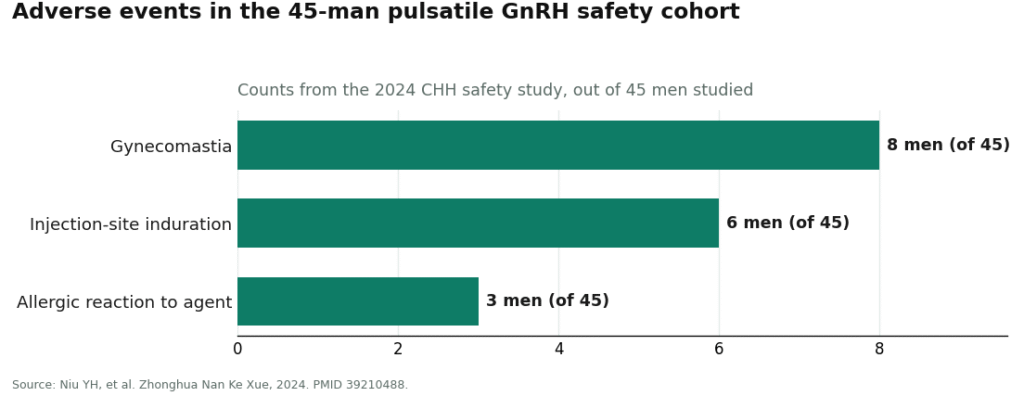
| Gynecomastia (breast tissue development) | 8 of 45 men in a safety study | [6] |
| Injection-site induration (hardening) | 6 of 45 men in the same study | [6] |
| Allergic reaction to the agent | 3 of 45 men in the same study | [6] |
| Estrogen-related side effects vs gonadotropin therapy | Fewer with pulsatile GnRH, per meta-analysis | [4] |
| Poor-response subgroup (efficacy, not harm) | Roughly 11% of patients | [5] |
| Delivery-related complexity | Trial-grade dosing requires a pulsatile pump | [1][3] |
| Regulatory safety status | No FDA-approved finished human product; compounded route only | [6] |
Notice that these eight rows don’t all rest on the same footing. Some come from one 45-person cohort. One comes from a meta-analysis of 8 studies. One is a regulatory fact, not a clinical finding at all. Keeping those tiers separate is most of the discipline this topic requires.
Reading the rows without rounding up
“Effective and safe” is an investigator’s summary, not a guarantee
The clearest tolerability statement comes from a 2024 study of 45 men with congenital hypogonadotropic hypogonadism on pulsatile GnRH therapy. Roughly 73 percent achieved spermatogenesis, and the researchers described the approach as effective and safe [6]. That’s a legitimate finding from the people who ran the trial, and it shouldn’t be dismissed.
But notice what tier of claim this is: it’s an investigator’s overall characterization of one cohort, not a guarantee applicable to every user. And the same paper that offered that reassuring summary is the paper that recorded gynecomastia, induration, and allergic reactions in that same group of men. “Judged safe on balance” and “produced measurable adverse events” aren’t contradictory. A scorecard that reports only the first half is doing marketing, not reporting.
See also: Tekno-Step: Mexico’s Premier Source for Luxury, Durable Flooring and Surfaces
Gynecomastia: 8 of 45, and it’s not a mystery why
Gynecomastia, breast tissue development, was the most frequent adverse event recorded, in 8 of the 45 men in that safety study [6]. That’s roughly one in six, which is not a rounding error you can wave off. The mechanism is unsurprising once you think about it: stimulating the gonadotropin axis raises testosterone, and some fraction of that testosterone aromatizes into estrogen, which can drive breast tissue changes in men prone to it.
What matters for a reader isn’t the mechanism so much as the base rate. One in six is exactly the kind of dose-dependent, monitorable effect a clinician can watch for, and exactly the kind of thing nobody catches if there’s no clinician watching at all.
Induration: 6 of 45, the boring but real one
Six of the 45 men developed induration, a hardening at injection sites [6]. It’s the least dramatic entry on the list, a local tissue reaction from repeated subcutaneous dosing rather than a systemic effect. But better than one in ten is common enough that anyone injecting this drug should expect it as a possibility, not a fluke, and should be rotating sites under some guidance rather than winging it.
Allergic reaction: 3 of 45, the row that kills the “it’s natural” argument
Three of 45 men had an allergic reaction to the agent itself [6]. Roughly one in fifteen. This is the number that most directly undercuts the “it’s just the body’s own hormone” framing, because a molecule being endogenous doesn’t make an administered version of it immune from triggering a reaction. It’s uncommon, not rare, and it’s the strongest single argument in this entire scorecard against anyone self-administering this compound with zero medical oversight.
A genuine point in gonadorelin’s favor, stated plainly
Not every row here is cautionary, and skipping the favorable one would be its own kind of dishonesty. A 2021 systematic review and meta-analysis, 8 studies, 420 patients pooled, found pulsatile GnRH therapy associated with fewer estrogen-related side effects than gonadotropin therapy, along with earlier spermatogenesis [4]. That’s a higher evidence tier than the single-cohort rows above it, pooled across studies rather than drawn from one, and it’s a real tolerability edge relative to the main clinical alternative.
The honest addendum, from the same analysis: no statistically significant difference turned up in overall successful sperm production, sperm concentration, or pregnancy rates between the two therapies [4]. So the tolerability advantage is real. A matching efficacy advantage on the outcomes people actually care about is not proven. Reporting one without the other would be cherry-picking.
The poor-response row is a different category of risk entirely
One line on this scorecard isn’t about harm at all, it’s about the treatment simply not working, and it deserves its own bucket. An 82-patient study found about 11 percent of patients fell into a poor-response group, with baseline testosterone and stimulated FSH flagged as predictors, and LH climbing on average from about 0.4 to 7.5 IU/L on therapy [5]. Roughly one in nine people here isn’t harmed by gonadorelin, they’re just disappointed by it, and the only way to find out which group you’re in is with baseline and follow-up labs, not assumption.
Timing itself is a safety variable
The last row isn’t an adverse event, it’s a design constraint worth taking seriously: the trial-grade outcomes above were produced using a pulsatile pump [1][3]. GnRH has to arrive in pulses to keep the reproductive axis engaged; flat, continuous exposure can suppress the very system you’re trying to stimulate. That means getting the timing wrong is its own failure mode, separate from anything in the adverse-event list. It’s part of why structured, supervised dosing functions as a safety measure, not merely a convenience.
What this scorecard can’t tell you
Two caveats sit over the whole table, and skipping them would flatter the data more than it deserves.
First, the denominators. These are men with congenital hypogonadotropic hypogonadism, mostly on pump-delivered pulsatile regimens. The far more common real-world scenario, fertility preservation alongside TRT using self-administered subcutaneous injections, is a different population using a different delivery method. It’s supported more by mechanistic plausibility and clinical convention than by these specific trials. The side-effect mechanisms likely carry over. The exact percentages may not.
Second, scale. Much of the strongest recent data comes from a handful of specialized centers with modest cohorts, 45 here, 82 there. These are legitimate numbers from real studies, not large-scale post-marketing surveillance. Treat the scorecard as the best available estimate, not a settled census, and let it argue for monitoring rather than for false precision.
The honest bottom line
Put the rows together in order of evidence strength and a coherent, unglamorous picture emerges, distinct from both flavors of claim this piece opened with.
In supervised, pulsatile use, gonadorelin looks reasonably tolerated, with investigators in the controlled data calling it effective and safe [6]. It carries a small, recurring, non-exotic set of real adverse events: gynecomastia in about one in six, injection-site induration in better than one in ten, allergic reaction in about one in fifteen, in the cohort that reported them [6]. It holds a genuine, pooled-data tolerability edge over its main clinical comparator on estrogen-related effects, without a matching proven edge on core efficacy outcomes [4]. About one in nine may simply not respond well, a fact you only learn by measuring [5]. And its trial-grade delivery method, a pump, makes dosing timing its own safety variable [1][3].
Every one of those signals points the same direction: manageable, monitorable, not something to shrug off and not something to panic over. None of it is the kind of thing caught by a vial arriving in the mail with no one checking your labs.
Which is also where the legitimate, monitored version of this drug actually comes from. There is no FDA-approved finished human gonadorelin product on the US market. The old branded versions are gone, and what’s labeled today is veterinary [6]. So the supervised route for men runs through a licensed compounding pharmacy on a prescription. FormBlends operates on that side of the line: gonadorelin is dispensed as a compounded prescription through a licensed pharmacy with a clinician involved, which is what turns each row of this scorecard from an abstract base rate into a number somebody has actually agreed to watch for. That compounded preparation is not an FDA-approved finished product, and the value of going the supervised route is the monitoring itself, not any implied stamp of approval.
Gonadorelin use in men is off-label and prescription-only. The compounded preparation is not FDA-approved as a finished product. Your individual risk is a matter for you and a licensed clinician, not a scorecard.
What people usually want to know
What’s the single most common side effect in the trial data?
Gynecomastia. It showed up in 8 of 45 men in the 2024 safety study of pulsatile GnRH therapy [6], roughly one in six. It’s not a random reaction. Stimulating the gonadotropin axis raises testosterone, and some of it aromatizes into estrogen, which can drive breast tissue changes in men prone to it.
How often does an actual allergic reaction happen?
In the same 45-man cohort, 3 men had an allergic reaction to the agent itself, about one in fifteen [6]. That’s uncommon, not rare, and it’s the single number that most cleanly refutes the “it’s just an endogenous hormone” line of reasoning. It’s also the strongest argument against self-administering this without any clinical oversight.
Is pulsatile gonadorelin actually safer than gonadotropin therapy, or just marketed that way?
On the estrogen side, the pooled evidence backs it up. A 2021 meta-analysis of 8 studies covering 420 patients found pulsatile GnRH therapy associated with fewer estrogen-related side effects than gonadotropin therapy [4]. But that same analysis found no statistically significant difference in successful sperm production, sperm concentration, or pregnancy rate between the two approaches. So the tolerability edge is real. Treat any claim of superior efficacy with more skepticism than the data currently supports.
Do these trial percentages apply to someone using gonadorelin alongside TRT?
Not cleanly, no. These figures come from men with congenital hypogonadotropic hypogonadism, mostly on pump-delivered regimens in supervised studies. The far more common real-world use, preserving fertility and testicular function during TRT via self-administered subcutaneous injections, is a different population on a different delivery method. The mechanisms behind each side effect likely still apply. The precise percentages are a reasonable estimate, not a guarantee.
Why does the trial-grade dosing require a pump at all?
Because GnRH only works if it arrives in pulses. Continuous, flat exposure can suppress the reproductive axis instead of activating it, which is why the best trial outcomes used pulsatile pump delivery [1][3]. Practically, this means the timing of dosing is its own variable to get right, separate from the listed adverse events, and it’s part of why supervised, structured protocols matter for safety and not just for results.
Is there an FDA-approved gonadorelin product for men in the US?
No. There’s no FDA-approved finished human gonadorelin product on the market; the branded versions were discontinued, and what’s currently labeled is veterinary [6]. For men, this is off-label use, and the only above-board route is through a licensed compounding pharmacy on prescription. The point of that route is clinical oversight and lab monitoring, not a regulatory stamp that doesn’t currently exist for this preparation.
Primary sources
- Niu YH, et al. “Effect and safety of pulsatile GnRH therapy for male congenital hypogonadotropic hypogonadism.” Zhonghua Nan Ke Xue (National Journal of Andrology), 2024. PMID 39210488. https://pubmed.ncbi.nlm.nih.gov/39210488/
- Wei C, et al. “Spermatogenesis of Male Patients with Congenital Hypogonadotropic Hypogonadism Receiving Pulsatile Gonadotropin-Releasing Hormone Therapy Versus Gonadotropin Therapy: A Systematic Review and Meta-Analysis.” The World Journal of Men’s Health, 2021. PMID 32777865. https://pubmed.ncbi.nlm.nih.gov/32777865/
- Mao JF, et al. “Predictive factors for pituitary response to pulsatile GnRH therapy in patients with congenital hypogonadotropic hypogonadism.” Asian Journal of Andrology, 2018. PMID 29516878.
- Jiang H, et al. “Therapeutic effects of a pulsatile GnRH pump on adult male patients with congenital hypogonadotropic hypogonadism (CHH): a retrospective study.” Translational Andrology and Urology, 2025. PMID 40800099.
- Zhang L, et al. “The Pulsatile Gonadorelin Pump Induces Earlier Spermatogenesis Than Cyclical Gonadotropin Therapy in Congenital Hypogonadotropic Hypogonadism Men.” American Journal of Men’s Health, 2019. PMID 30569789.
- U.S. National Library of Medicine, DailyMed. Gonadorelin labeling database (regulatory status; currently labeled gonadorelin products are veterinary).
What is gonadorelin, and how is it different from the synthetic GnRH analogues people confuse it with?
Gonadorelin is a synthetic copy of the body’s own gonadotropin-releasing hormone, a ten-amino-acid peptide made in the hypothalamus. Longer-acting analogues like leuprolide or nafarelin are chemically tweaked to last longer, which eventually suppresses the pituitary. Gonadorelin matches the native sequence exactly, so it stimulates the pituitary the way the body would, rather than shutting it down over time. That distinction is why it shows up in fertility and hypogonadism protocols where keeping the HPG axis running matters.
What happens biologically once gonadorelin reaches the pituitary?
It binds GnRH receptors on pituitary gonadotroph cells and triggers LH and FSH release within minutes. LH tells the testes to make testosterone and keeps Leydig cells active, which matters specifically for men on TRT. FSH supports sperm production. The effect fades quickly by design, which is exactly why pulse timing is so consequential in these protocols, and why a single daily shot behaves nothing like a pump delivering true pulses.
Is it actually legal to get gonadorelin in the US?
Gonadorelin isn’t a controlled substance, but the legitimate path to it is narrower than people assume. Since there’s no FDA-approved finished drug product for men, the only fully accountable route is a prescription filled by a licensed compounding pharmacy. Research-chemical sites will sell it with no prescription at all, which puts the buyer entirely outside any regulatory or clinical framework. A pharmacy like FormBlends works under physician supervision and state pharmacy board oversight, which is a meaningful, checkable difference from an unregulated vendor.
Does the trial evidence actually support using gonadorelin to preserve fertility during TRT?
The data lean encouraging, but they’re thinner than the confidence with which this claim sometimes gets stated. Published studies show gonadorelin can maintain measurable LH pulses and prevent the full testicular atrophy that TRT alone causes, and smaller case series report preserved sperm parameters in men trying to stay fertile. What’s missing is a proper randomized controlled trial specifically in the TRT-adjunct setting, so calling this settled science overstates where the evidence actually sits. The mechanism is credible. The long-term outcome numbers aren’t there yet.
Written by Bianca Okafor, features writer. Last reviewed January 2026.
Not medical advice. Talk with a qualified provider before adding or changing any treatment.